

BLOG POST

Event Gamification: Turning Participation Into Purpose

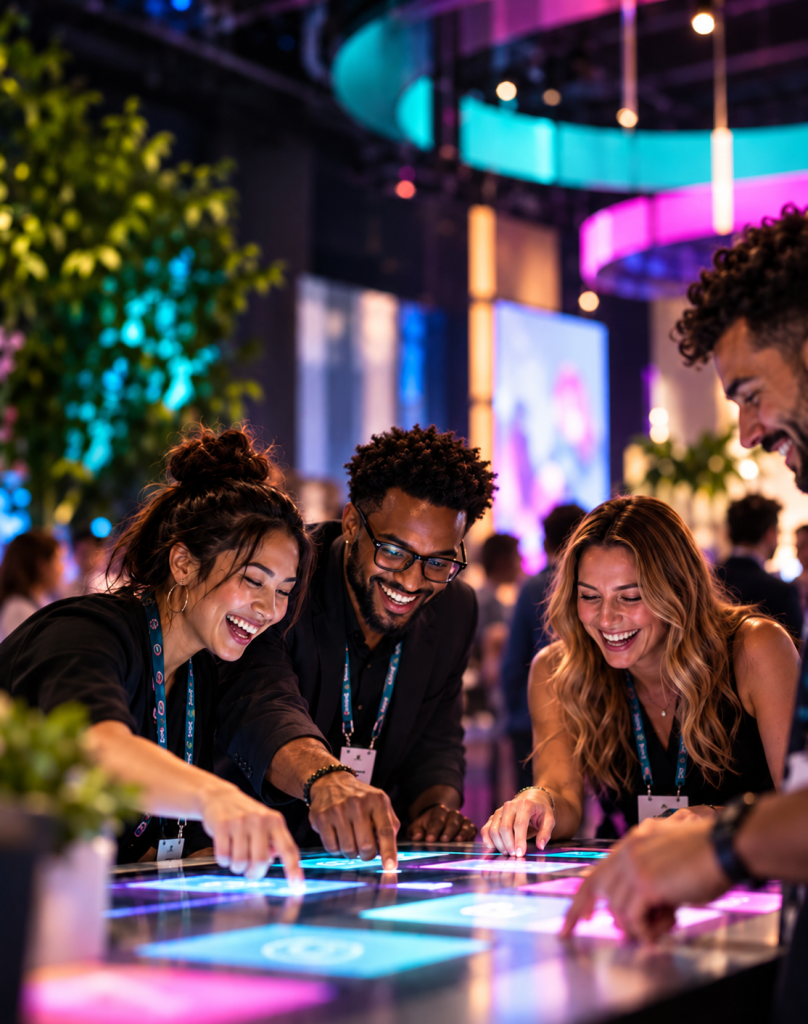
event attendees participating in games

Updated October 2026 | 5-min. read

Event gamification has evolved far beyond superficial points, badges, and prizes. Today, it’s a strategic approach to event experience design—one that turns passive attendance into active motivation, connection, and measurable business outcomes.

As expectations for corporate gatherings rise, modern audiences demand more than slide presentations. They want to engage with it, influence their environment, and connect with peers. Because more engaged employees directly correlate with organizational performance, gamification for events has become one of the most effective tools for driving sustained focus at sales kickoffs, annual conferences, leadership meetings, and incentive programs.

What Is Event Gamification (and What It Isn’t)

Event gamification applies the principles of play (challenges, rewards, progress, and storytelling) to professional experiences. At its core, it’s rooted in behavioral psychology, tapping into universal motivators like curiosity, achievement, competition, and recognition.

What event gamification isn’t: 

  • It isn’t turning your corporate conference into a video game
  • It isn’t a surface-level distraction from your core message
  • It isn’t a gimmick applied without an objective 


When designed with intention, meeting gamification supports the broader event strategy. It creates a natural framework for attendee movement, encourages intentional networking, and makes learning feel rewarding, without ever overshadowing your primary business objectives. 

Event gamification isn’t about play. It’s about purpose.

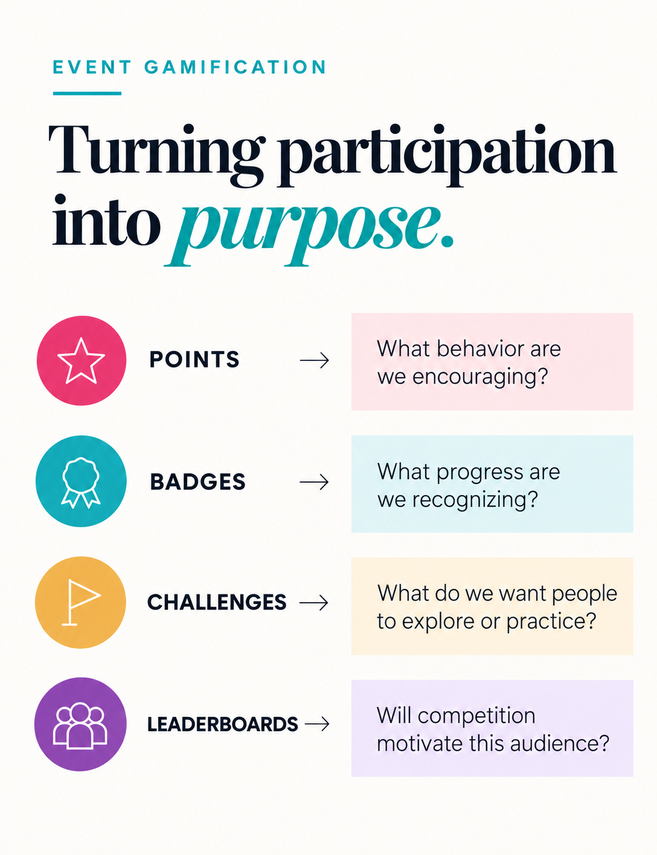
turning participation into purpose

Why Event Gamification Matters Now

Passive attendance no longer delivers return on investment. Today’s corporate audiences expect experiences to feel interactive, personalized, and worthy of their time.

Deploying strategic conference gamification replaces passive listening with an active attendee journey. When aligned with your strategic goals, event gamification:

  • Increases Attention & Retention: Keeps attendees active and focused during dense content delivery

  • Uncovers Behavioral Insights: Generates real-time data on what content attendees value, where they spend time, and how they learn

  • Strengthens Community: Encourages authentic peer-to-peer networking and team alignment

  • Reinforces Learning & ROI: Extends message retention, brand advocacy, and post-event action.
     

This is where engagement becomes measurable, and where participation converts directly into business insight.

How Gamification for Events Drives Real Outcomes

The most successful gamified experiences begin with a clear objective, not a feature list. Whether designing meeting gamification for executive sessions or conference gamification for thousands, the mechanics must serve your business goals: 

  • Driving Engagement & Traffic: Guiding movement across exhibit halls, sponsor activations, or breakout sessions.


  • Reinforcing Training & Knowledge: Tying rewards and recognition to demonstrated mastery rather than simple presence.


  • Gathering Real-Time Feedback: Transforming post-session surveys from administrative chores into rewarding interactive moments.


  • Accelerating Relationship-Building: Facilitating structured icebreakers and cross-functional team challenges.
a meaningful journey

In Practice: Gamification in Action

At a recent Customer Solutions Expo, event gamification guided attendee movement, rewarded curiosity, and reinforced learning throughout the space. Participants earned points for visiting booths, completing quizzes, scanning QR codes, and uncovering hidden challenges—creating focused energy and intentional engagement across the program.

In sales training environments, gamification ensured mastery by tying rewards to demonstrated knowledge rather than passive participation. And when feedback was the priority, points and on-site redemption transformed surveys into moments of engagement instead of obligations.

Across every use case, the success came from the same place: gamification at events that was designed around behavior, not novelty.

Designing Event Gamification with Intention

Effective event gamification isn’t one-size-fits-all. It works best when scaled to the audience, the moment, and the desired behavioral outcome.

Depending on the event, that might mean: 

  • Light-Touch Interactions: Quick, high-impact interactions that spark instant participation during keynotes or panel discussions.


  • Integrated Experience Journeys: Comprehensive multi-day frameworks where conference gamification shapes how participants learn, connect, and navigate the entire event environment.


At Creative Group, we leverage our proprietary i|xperience® framework to ensure every game mechanic connects directly back to what your organization needs to accomplish.

event attendees participating in games

Your Event Has a Job to Do. Let’s Design for It.

Gamification works because it taps into something deeply human: the desire to participate, to progress, and to belong. When designed with intention, it shifts the attendee mindset from “I’m here” to “I’m part of this.” Participation becomes energy. Engagement becomes insight. And experiences deliver outcomes that last well beyond the event itself.

Read Content

large sales event with people gathered in a restaurant setting

The Complete Guide to Sales Meeting Event Strategy

A strong sales meeting starts long before the agenda is built. This guide explores how corporate event strategy can help enterprise teams align around business priorities, design for engagement, create space for connection, and measure what actually changes after the meeting.

Irish dancer performing on a table amongst attendees at an event

Psychology of Novelty & Event Experience Design

Novelty does more than capture attention. Rooted in behavioral science, it can spark curiosity, strengthen memory, and turn recognition into an experience that feels meaningful long after the moment ends.